

















Donkey Kong makes progress visible: the goal is above you, and hazards interrupt the climb. Nintendo released the arcade game in 1981, with Shigeru Miyamoto’s character-led design establishing a different kind of challenge from a screen-clearing shooter. The Strong describes its story across four scenes and its importance to Nintendo’s later success.
The game’s clear objective does not make every next move obvious. A useful first practice goal is to recognise a safe opportunity to move, rather than trying to maximise points immediately. The exercise below is our suggested way to study decisions; it is not a guaranteed route or a recorded expert run.
Separate the route from the timing
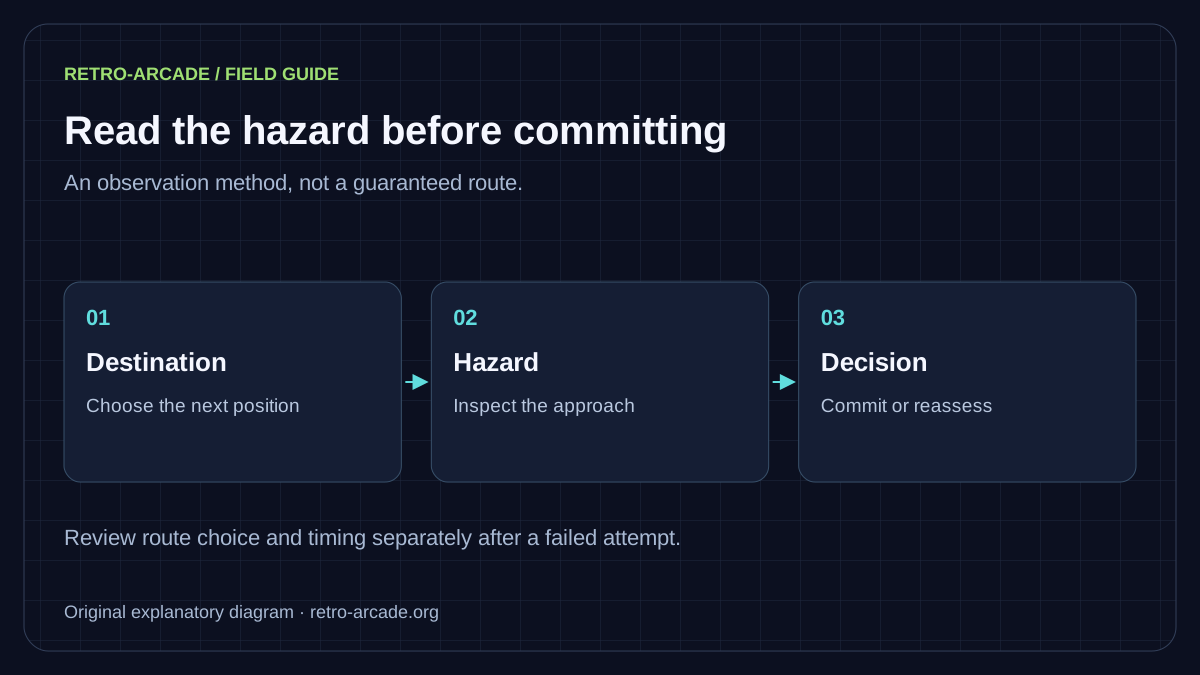
When a run fails, ask two questions. Was the destination a sensible one? Was this the right moment to move towards it? A ladder can be part of a reasonable route and still be dangerous at the instant you begin climbing. Blaming the whole route for a timing mistake makes it harder to learn from the next credit.
Before committing, look at the platform you are leaving, the landing area, and nearby moving hazards. If you cannot describe where you intend to stand next, slow the decision down. That does not mean waiting indefinitely: the game’s time pressure also matters.
Use each attempt to answer one question
| Focus | What to record | What to change next |
|---|---|---|
| A missed jump | Where the hazard was when you pressed Jump. | The timing of that one input. |
| A dangerous climb | What occupied the destination before you entered the ladder. | Look at the landing area before committing. |
| A scoring detour | What you gained and which exit it left available. | Compare the detour with a direct attempt. |
| A new scene | Which hazard or objective was unfamiliar. | Learn that scene’s rule before chasing a total. |
A score alone cannot tell you whether a route decision improved. A lower-scoring attempt that reaches an unfamiliar scene may provide more useful practice than repeating a comfortable opening for bonus points. Once survival is consistent, add one scoring opportunity at a time and observe its cost.
Why the arcade version matters
The original game has four scene designs. A home conversion should not be assumed to contain the same sequence, graphics, or timing. Nintendo’s interview with Miyamoto discusses development and the later Famicom/NES version; it is a useful source for separating the arcade design from memories of a home cartridge.
The record linked here is Donkey Kong, US set 1. Identify the set before comparing a route from a video or a score from another release. We do not reproduce a full stage-order chart here because a route needs a defined version and level context.
Check the input before judging the jump
Our listed mapping uses the arrow keys for movement and X for Jump, with V for a credit and Enter for Start. If a mapped action does not register, focus the player and test that input separately. A missed command and a mistimed command are different problems.
On a phone, check whether you can move and jump together without covering the destination. Try the touch-control assessment before deciding that a cabinet is a good fit for your device. Current access requirements appear on the game page; this guide is freely readable and does not promise that game access is free.
History and sources
For historical background, use The Strong’s Donkey Kong entry and Nintendo’s interview with Shigeru Miyamoto. The practice table and diagram are our editorial suggestions, distinct from those historical accounts. They make no claim of hardware benchmarking or competitive record validation.
What players are saying…
No comments have cleared the cabinet yet. Be the first player to join in.
Leave your comment
Sign in with a confirmed player account to join the conversation.
Sign in to comment