














Four ghosts can arrive at the same junction for different reasons. In the original Pac-Man, each ghost uses a target tile, and that target changes with its mode and identity. Knowing the target helps explain an apparently surprising turn. It does not let you predict a whole run without considering the other ghosts, the clock, and the maze.
This guide covers the original arcade game. Ms. Pac-Man and later games change the rules. The technical reference is Jamey Pittman’s Pac-Man Dossier, based on examination of the game code. The numbered example and diagram below are our own explanatory construction, not a captured game state or a recommended maze route.
First identify the mode
In chase mode, the four individual targeting rules apply. In scatter mode, each ghost ordinarily aims towards its own corner outside the playable maze. Frightened mode, following a Power Pellet where the level permits it, changes movement and allows the ghosts to be eaten. The chase/scatter schedule can order a reversal; ghosts do not normally reverse whenever Pac-Man changes direction.
There are exceptions worth keeping separate from the basic model. Late-board Blinky can continue targeting Pac-Man during scatter. A ghost returning to the house after being eaten is another state. A blue ghost is therefore not simply running the usual chase formula with a slower speed.
One position, four targets
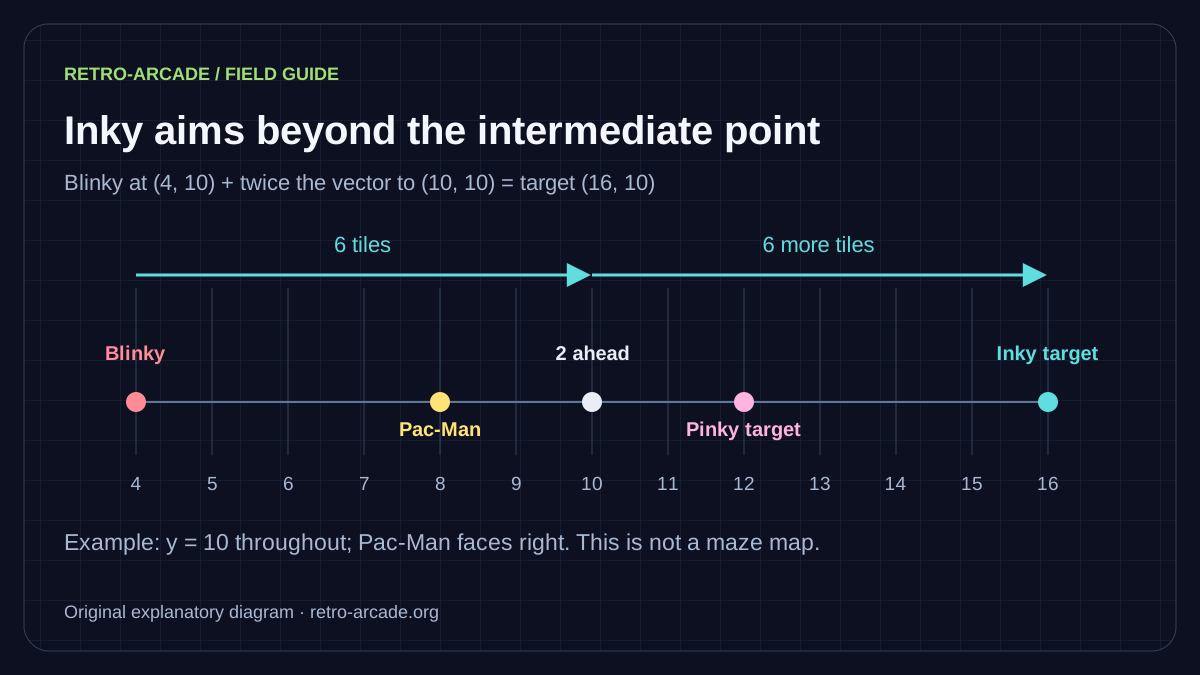
Use an imaginary grid with x increasing rightwards and y increasing downwards. Put Pac-Man at (8, 10), facing right, and Blinky at (4, 10). These coordinates illustrate the calculation; they are not the original maze’s coordinate origin.
| Ghost | Rule | Result |
|---|---|---|
| Blinky | Target Pac-Man’s current tile. | (8, 10) |
| Pinky | Target four tiles ahead of Pac-Man. | (12, 10) |
| Inky | Double the vector from Blinky to a point two tiles ahead of Pac-Man. | (16, 10) |
| Clyde | Use Pac-Man’s tile at a straight-line distance of at least eight tiles; otherwise use his scatter target. | Depends on Clyde’s own position. |
To calculate Inky, first find the intermediate point: two tiles right of (8, 10) is (10, 10). The vector from Blinky at (4, 10) to that point is (6, 0). Extend that vector by the same amount again: (10, 10) + (6, 0) = (16, 10). Inky’s own location affects which way he turns towards the target, but it is not an input to this target calculation.
Change one input and see what follows
Keep Pac-Man at (8, 10), still facing right, but move Blinky to (6, 10). The intermediate point stays at (10, 10). The first vector is now (4, 0), so Inky’s target becomes (14, 10). Blinky moved two tiles towards the intermediate point, and Inky’s target moved two tiles back towards it. Pinky’s target did not move.
Now put Clyde at (0, 10). His distance to Pac-Man is exactly eight tiles, so he targets Pac-Man. Move Clyde to (1, 10): the distance is seven, and he uses his scatter target instead. Count straight-line tile distance, not the length of a route through corridors. This threshold explains a change in intent; it does not guarantee Clyde will turn away immediately at his current position.
A target is not a path
A ghost chooses among legal directions by comparing candidate tiles with its target. It does not plan the shortest complete route through the maze. Ordinary immediate reversals are excluded, ties follow a fixed preference, and some junctions restrict upward turns. Targets can lie outside the maze; the ghost still makes local choices towards them.
That distinction is useful when reviewing a mistake. Ask where the ghost was aiming, then ask which exits were legal. A turn that takes it away from the player may still fit its target. Watching only the nearest ghost is risky because another ghost can approach from a different direction.
The upward-facing exception
Our arithmetic used a right-facing Pac-Man deliberately. In the original code, facing upwards also shifts Pinky’s intended target four tiles left. Inky’s intermediate point similarly shifts two tiles left. Do not apply the simple “straight ahead” diagram unchanged to that case. The Dossier documents these quirks and the additional movement rules in detail.
A useful practice exercise
During an ordinary, non-ranked run, choose one junction to observe instead of trying to memorise the whole maze. Note Pac-Man’s facing direction, Blinky’s position, and whether the ghosts are blue or have just reversed. After a loss, sketch those positions and calculate the possible targets. If the sketch cannot explain a turn, check mode changes and legal exits before assuming randomness.
This is a study method, not a tested high-score pattern. It is more useful to explain one decision correctly than to promise that a route will always be safe. Consult the game page for the set, current access requirements, and controls.
Sources and scope
- The Pac-Man Dossier: modes, targeting, intersections, and exceptions.
- Bandai Namco’s PAC-MAN history: series chronology.
- The Strong: Pac-Man: historical context.
The coordinates above were selected for explanation and checked by arithmetic. They are not a claim that we reproduced those exact positions in a live game.
What players are saying…
No comments have cleared the cabinet yet. Be the first player to join in.
Leave your comment
Sign in with a confirmed player account to join the conversation.
Sign in to comment