

















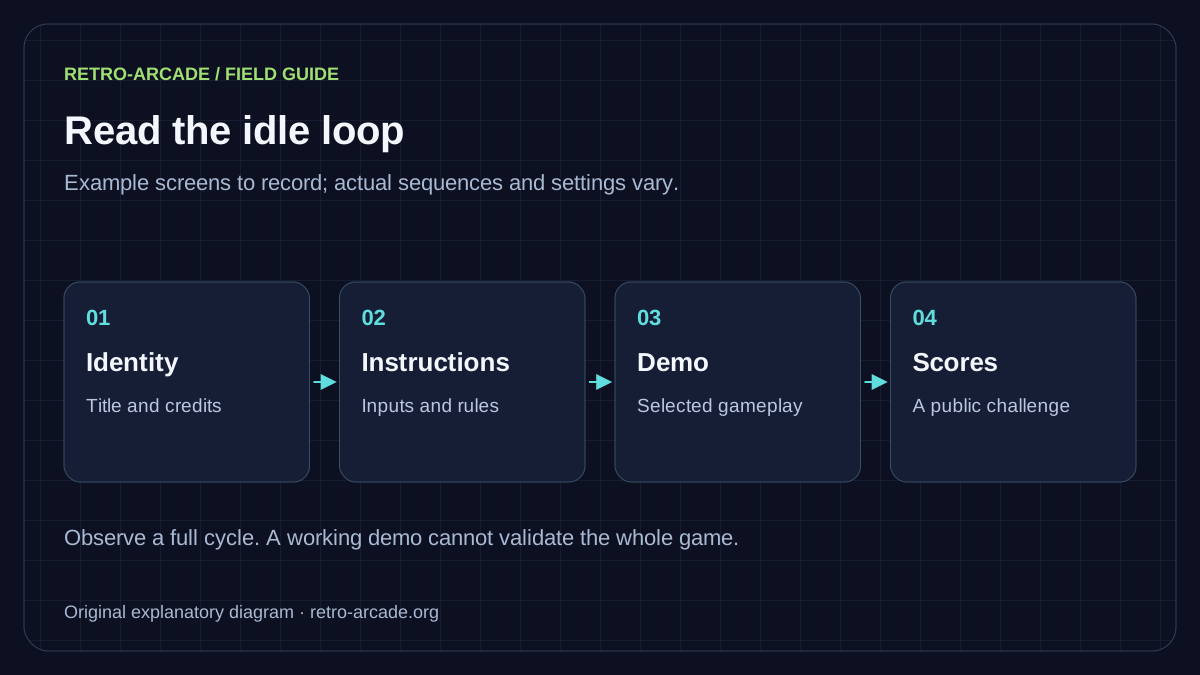
Before inserting a coin, let a cabinet run. Its idle sequence can reveal the title, controls, score table, and a short demonstration. This is usually called attract mode. It invites a passer-by to play, but it is also a useful way to study what the machine chooses to explain first.
There is no universal sequence or duration. A particular set may omit a demonstration, show different legal text, or use operator settings that change the sound. An emulator reaching an attract screen is evidence that part of the program runs; it is not proof of complete emulation accuracy.
Separate four jobs that often share one loop
| Screen | Look for | What it can tell you |
|---|---|---|
| Identity | Title, copyright line, region, credits | Whether the displayed identity matches the catalogue entry. |
| Instructions | Named buttons, scoring illustrations, player count | What a newcomer is expected to know before a credit. |
| Demonstration | Movement, hazards, transitions, repeated actions | Which parts of play the program presents as its introduction. |
| Score display | Initials, ranking, starting values | How the cabinet presents a challenge between games. |
Make a small observation sheet
Record the game’s complete set label and emulator version if available. Start a timer when the first recognisable title screen appears. Write down each transition as it happens: “title to instructions”, “instructions to demo”, and so on. Continue until the same sequence begins again. If the loop changes on a second pass, record that rather than forcing it into the diagram.
Use separate columns for what you saw and what you inferred. “The screen names a jump button” is an observation. “The designer wanted players to learn jumping before moving” is an interpretation, and may need developer testimony to support it. This separation keeps a useful cabinet note from becoming an invented design history.
A practical comparison is to watch a maze game and a shooter. Count how many distinct actions each demonstration makes visible. Does it show the objective, only survival, or a scoring trick? Then read the instructions and see whether they answer a question the demonstration left open. The goal is a specific comparison between the two sets you inspected, not a ranking of entire genres.
Silence has more than one explanation
An idle cabinet may be silent by design or because a demo-sound setting is off. In a browser there is another possibility: audio playback can be restricted until the visitor interacts with the page. Click or tap the player, check device and tab volume, and compare sound during normal play before reporting a missing attract tune.
Do not infer an emulation defect merely because an online recording has different audio. The recording may use another set, operator configuration, emulator, or capture setup. MDN’s autoplay guide explains the browser interaction requirement.
What a loop cannot validate
A demonstration may never visit a late level, exercise a second-player input, or trigger a particular sound effect. A clean-looking loop cannot validate those paths. Nor can it settle display colour, timing, or analogue-control accuracy without a reference machine and a controlled comparison.
For the same reason, “it looks familiar” is a useful personal reaction but a weak test result. A stronger report states the set, what repeated, what failed, and which settings differed. If a fault occurs at exactly the same transition on repeated launches, that is a much more actionable observation than “the game is wrong”.
Turn the observation into a useful report
Include the game page, browser and device, approximate point in the sequence, and whether normal play has the same problem. If you have a reference, identify its version and source. Avoid changing several settings at once: you lose the ability to tell which change affected the result.
See our guide to identifying a game set before comparing two machines. MAME’s ROM-set documentation explains why a shared title does not establish that two program sets are interchangeable.
What players are saying…
No comments have cleared the cabinet yet. Be the first player to join in.
Leave your comment
Sign in with a confirmed player account to join the conversation.
Sign in to comment