















One way to understand early arcade design is to compare what changes between one decision and the next. Pong asks you to return a moving ball. Space Invaders changes the pressure as the enemy formation thins. Donkey Kong makes a destination visible while hazards interrupt the route. Their dates matter, but their different demands on attention explain more than a timeline alone.
This essay uses three documented games as examples. It does not claim that each invented every mechanic discussed, or that these three represent the whole history of arcades. The comparison is our interpretation of their play structures; the museum sources below establish the historical background.
Pong: the next return
Atari released Pong in 1972. Its table-tennis-like exchange gives each player an immediate task: position the paddle for the arriving ball. The next decision is easy to locate because the ball’s movement and the paddle occupy the same visible field.
For a design comparison, ask where your attention goes just after a successful return. You stop defending the previous contact and start reading the next exchange. That cycle creates a conversation between players even with very little on screen. A reader studying the game can note how the opponent’s position changes the meaning of the same ball trajectory.
Space Invaders: pressure that changes during a wave
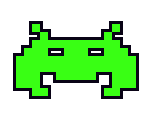
Taito’s Space Invaders arrived in 1978. The descending formation, defensive position, and accelerating action make progress feel different from a simple reduction in the number of enemies. Clearing the screen also changes the situation you are trying to survive.
Our useful comparison question is whether success makes the next moment easier. In a score-chasing game it need not. A thinner formation can demand a different rhythm from a full one. When watching a run, mark a few points in the wave and describe how the player changes movement and firing choices rather than recording only the total destroyed.
Donkey Kong: progress with a destination
Nintendo’s 1981 Donkey Kong gives the climb a character-led objective. The Strong describes the original game across four scenes. The visible goal gives movement a direction, while hazards make the timing of each commitment significant.
A ladder is both progress and a temporary choice of route. That makes “move towards the goal” an incomplete strategy. The player has to read the space they are entering. Our Donkey Kong practice guide separates route selection from the moment of commitment.
| Game | Immediate question | Observation to make |
|---|---|---|
| Pong | Where should the paddle meet the ball? | How each return changes the next exchange. |
| Space Invaders | How should I respond to the changing formation? | How behaviour changes within one wave. |
| Donkey Kong | When should I commit to the next part of the climb? | How a sensible destination can still have unsafe timing. |
Turn the comparison into an observation
Watch or play a clearly identified version. Choose a short section and write down three decisions, the information available before each, and what changed afterwards. Keep your observations separate from claims about the designer’s intent. To say “the player changed direction” you need an observation; to say why the designer wanted that moment, you need stronger evidence.
Also identify the version. A home conversion, altered set, or modern remake can change the conditions. The version guide explains what to record before treating two experiences as equivalent.
Sources
- The Strong: Pong, for its release and historical context.
- The Strong: Space Invaders, for the game and its significance.
- The Strong: Donkey Kong, for its scenes and character-led design.
For a wider chronology, continue to Arcade History. The three questions above are a way to inspect design, not a claim that one game is objectively better than another.
What players are saying…
No comments have cleared the cabinet yet. Be the first player to join in.
Leave your comment
Sign in with a confirmed player account to join the conversation.
Sign in to comment